
Strategy, business model, and value chain of the KION Group (SBM-1)
The KION Group is among the world’s leading suppliers of industrial trucks and supply chain solutions. Across the Group, it employed 43,021 people from more than 110 countries as at December 31, 2025 (December 31, 2024: 43,297). The EMEA region and the key market of western Europe accounted for the largest share of the workforce with 67.4 percent (29,014 employees) at the end of the year (2024: 69.3 percent, 30,018 employees). The APAC region and the key market of China accounted for 17.7 percent (7,602 employees) (2024: 16.9 percent, 7,307 employees). The Americas region, including the key market of North America, accounted for 14.9 percent (6,405 employees) (2024: 13.8 percent, 5,972 employees).
Through its regional market presence, the KION Group has positioned itself in the global markets with the product portfolio of its established brands, its sales and service network, and its varied customer portfolio. The business is combined in the two operating segments Industrial Trucks & Services and Supply Chain Solutions, which complement each other thanks to their respective market position and regional presence. Corporate Services comprises holding companies and other service companies that provide services such as IT and general administration activities across all segments.
Its portfolio includes industrial trucks – such as forklift trucks and warehouse trucks – and related services, including complementary financial services. The portfolio also encompasses integrated automation technology and software solutions for the optimization of supply chains, including all related services. Across more than 100 countries worldwide, the KION Group sells logistics solutions that improve the flow of material and information within factories, warehouses, and distribution centers. The KION Group, whose shares are included in the MDAX, is the largest manufacturer of industrial trucks in the EMEA region. In China, it is the leading foreign manufacturer.
The ITS segment’s business model and brands have been established in the regional markets EMEA, APAC, and the Americas for decades. The Linde and STILL brands serve the premium and higher value segments of the industrial truck market. Baoli focuses on industrial trucks in the lower value and economy segments. The regional industrial truck brand Fenwick is one of the leading suppliers of material handling products in France, while OM is among the leading vendors in the Indian market. The Industrial Trucks & Services segment has a diversified customer base. Customers range from large key accounts with global operations to small and medium-sized enterprises across all sectors.
The business model in the Supply Chain Solutions segment, which operates under the Dematic brand, focuses on concept development for, and the installation of, integrated technology and software solutions that are used to optimize supply chains. As a global leader in warehouse automation solutions, Dematic offers a comprehensive range of intelligent supply chain and automation solutions. With its production sites and regional teams of experts, Dematic is able to plan and deliver logistics solutions of varying complexity around the world. Key customer industries are general merchandise, grocery retail, apparel, and food and beverage. Customer groups include manufacturers, the food and beverage industry, parcel delivery services, and pure-play e-commerce companies.
Strategic sustainability management
Strategic sustainability management is a driver of innovation and growth in the ‘Playing to Win’ corporate strategy, which was launched in 2025 (see also ‘Strategy of the KION Group’). The KION Group firmly believes that enshrining sustainability in the corporate strategy contributes to profitable growth, resilience, and customer focus. It also promotes the successful development of sustainable products and services, and reinforces a sense of responsibility for employees, the environment, and society. Building sustainability into the entire value chain starts with product design and encompasses the supply chain, the KION Group’s own operations, logistics processes, and the lifecycle of the products, solutions, and services offered. By focusing on sustainability, the KION Group strives to offer its customers safe products that are manufactured in the most resource-efficient and energy-efficient way possible in a work environment that is safe and free from discrimination.
The global research and development activities, with their focus on intelligent, networked automation solutions, energy-efficient drive solutions, and software for optimizing energy management, play their part in achieving the groupwide sustainability targets. Through its business model and strategy, the KION Group pursues the goal of offering increasingly integrated, circular, and emission-free intralogistics solutions in order to contribute to emission reduction. This includes the manufacture of low-emission industrial trucks with alternative drives and the further development of robotic and automation solutions. The KION Group has officially committed to net zero by no later than 2050 and is guided by the international framework of the Science Based Targets initiative (SBTi). This requires responsible practices along the entire value chain.
In the Industrial Trucks & Services segment, the KION Group’s own operations focus on a portfolio of electric trucks, including products powered by batteries and fuel cells. The proportion of industrial trucks ordered with an electric drive system amounted to 92.6 percent in the reporting period.
The KION Group’s Hamburg facility has been manufacturing high-performance, 24-volt fuel cell systems for industrial trucks since 2023. Lithium-ion batteries have been made by KION Battery Systems GmbH (KBS) in Karlstein am Main since 2020. In November 2025, the opening of a new center of competence for energy at the Hamburg site saw the KION Group bring the first production line for custom lithium-ion batteries on stream, thereby further boosting its production capacity for energy-efficient energy systems at sites outside China. In addition to its used truck business, the KION Group also stepped up its efforts to reuse materials in line with the principles of the circular economy. It has had a strategic partnership with Li-Cycle Holdings Corp. in Magdeburg, Germany, for the recycling of lithium-ion batteries since 2023.
In the project business for automation solutions, the aim is to integrate innovative drive technologies into the standard product ranges in order to harness the use of electricity more efficiently and to help customers to reduce their energy consumption. Cloud-native software solutions (IT/OT-driven solutions) are also being increasingly deployed. The Supply Chain Solutions segment offers tailored solutions for numerous cloud environments and helps customers to reduce their environmental footprint through lower material consumption and improved energy efficiency.
The ability of the KION Group’s two operating segments to mitigate risk in terms of supply capability, quality, costs, and sustainability along the supply chain is critical for the smooth running of the business. Substituting chemical substances that can be harmful to human health or the environment is one of the key principles by which the KION Group operates sustainably and responsibly. The KION Group is continuing to establish a stable supplier base in order to minimize disruptions to production and promote profitable growth. This is an integral element of the ‘Playing to Win’ corporate strategy, supporting growth and sustainability targets and helping to optimize the cost of materials. It should also encourage the circularity of supply chains and a range of sustainability-conscious products and solutions for customers in order to ensure profitability and competitiveness over the long term. Targeted supply chain management is therefore essential for ensuring the best possible traceability of materials along the value chain.
The KION Group’s sustainability activities are managed strategically on a groupwide basis. At its heart, the sustainability strategy is built around the guiding principle of ‘We take responsibility’ with its three strategic dimensions of people, products, and processes. Within these dimensions, eight overlapping sustainability action fields were initially defined in which each strategic target has been enshrined. In 2025, it was decided to no longer continue the ‘Production and solution safety’ action field as a separate key area of the sustainability strategy, as safety aspects are enshrined in ongoing product development as part of the KION Group’s business model. The sustainability strategy’s seven action fields are listed in the overview below:
Sustainability strategy – The seven action fields of the KION Group sustainability strategy
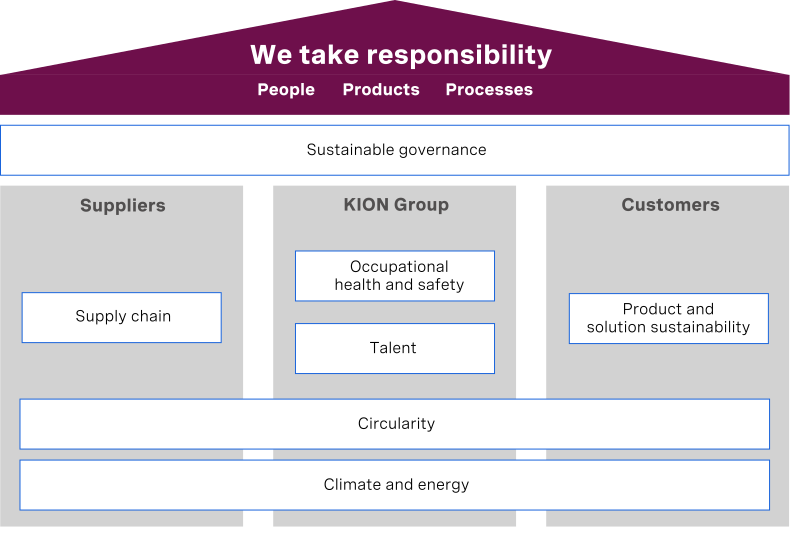
Strategy targets and target achievement in 2025
The KION Group’s sustainability strategy was further refined in 2025. In the year under review, the focus in the seven action fields was on increasing energy efficiency, cutting GHG emissions in own operations, and bringing down the lost time injury frequency rate (LTIFR) further by steadily reducing work-related accidents. The almost complete switch to electricity from renewable sources over the course of 2025 will significantly increase the share of sustainable energy sources used by the KION Group. In addition to driving the electrification of production processes and the fleet of company cars and service vehicles, the switch to green electricity supports the ‘Climate and energy’ action field’s strategic goal of gradually increasing the share of renewable energy used in own operations.
Employee satisfaction is a recurring material indicator of good business conduct; accordingly, this metric is measured and assessed across the workforce every year as a strategic target in the ‘Talent’ action field.
There were no changes to the targets in the ‘Climate and energy’ and ‘Product and solution sustainability’ action fields compared with the previous year. The net zero target of continuously reducing GHG emissions in Scope 1, 2, and 3 by no later than 2050 remains unchanged. ››In line with the SBTi‹‹ and with reference to 2021 as the base year, the medium-term target to be achieved by 2030 was defined as an absolute reduction of 42 percent for Scope 1 and 2 and of 25 percent for Scope 3. The target for the proportion of electric industrial trucks ordered by customers in the ITS segment will continue to be pursued at a minimum of 92 percent until 2027. A continual increase in products with lifecycle assessments and Cradle to Cradle certification was also set as a target.
The ‘Product and solution safety’ action field will now be managed by the KION Group’s technology organization (CTO) as part of the Group’s technology strategy.
In the ‘Circularity’ action field, the specific target value for an increase in waste recycling in the Company’s own operations at a minimum of 85 percent by 2030 remains in place.
In the ‘Supply chain’ action field, the target value for the annual procurement volume by value in relation to direct tier 1 suppliers in category A with a low ESG risk in the reporting year, to be achieved by 2030, was increased to 80 percent of spending because there had been a significant increase.
In the ‘Sustainable governance’ action field, the KION Group as a whole was awarded the top Platinum rating by EcoVadis for the first time, ahead of its target of 2027. This placed the KION Group in the top 1 percent of companies rated by EcoVadis. It thus followed in the footsteps of its well-established brands Linde and STILL in the EMEA region. For other selected subsidiaries, at least the ‘Silver’ rating from the previous year was confirmed again; moreover, one company achieved the ‘Silver’ rating for the first time after previously receiving ‘Bronze’. The plan is for further subsidiaries to improve their rating by 2027. The KION Group continues to aim for an S&P Global Corporate Sustainability Assessment (CSA) rating of at least 70 points by 2027, having improved its rating to 69 points in 2025.
The long-standing targets for complete certification of all KION Group sites in accordance with ISO 45001 (occupational health and safety) in the ‘Occupational health and safety (OHS)’ action field and ISO 14001 (environmental management) in the ‘Climate and energy’ action field were already achieved. These targets will remain enshrined in the sustainability strategy to ensure high standards with regard to health, safety, and the environment in the Group. Furthermore, the KION Group aims to continuously reduce the Group’s lost time frequency rate by maintaining a high standard of health and safety and therefore closely manages progress with the aim of achieving an annual reduction in work‑related accidents of at least five percent. In 2025, the annual target was achieved again, reaching 4.2 (2024: 4.4).
With the exception of the ‘Product and solution safety’ action field, all other objectives within the groupwide sustainability strategy continue to be pursued unchanged compared to the previous year (see ‘Interests and views of stakeholders’).
In the environmental field, further year-on-year improvements were achieved in GHG emissions and the share of renewable energies. The proportion of trucks sold with an electric drive increased again, reaching 92.6 percent at the end of 2025 (2024: 91.7 percent).
In the ‘Talent’ action field, the KION Pulse employee survey was conducted in October and November 2025 to assess employee satisfaction (engagement score). The very good level of employee satisfaction was reaffirmed by the score of 75 that was achieved (target of at least 75). External surveys showed that the participation rate across the workforce remained above the industry average at 81 percent.
In addition, further progress was made with the other medium- and long-term goals, or the prior-year status was confirmed once again successfully.
The following overview of the groupwide sustainability strategy includes a qualitative description of the short-, medium-, and long-term sustainability targets, of the quantitative metrics, and of their status at the end of 2025 compared with the end of 2024.
Dimension |
Action field |
Targets and indicators |
Target year |
Status 2025 |
Status 2024 |
||||||||||||||||||||||||
|---|---|---|---|---|---|---|---|---|---|---|---|---|---|---|---|---|---|---|---|---|---|---|---|---|---|---|---|---|---|
People |
Occupational health and safety |
Reduction of accident frequency rate1 by 5% per annum (based on the annual upper limit; long-term: no occupational accidents)* |
annually |
4.2 |
4.4 |
||||||||||||||||||||||||
100% ISO 450012 certification rate (all sites, with at least 12 months of company service) |
2025 |
99% |
99% |
||||||||||||||||||||||||||
KION HSE Assessment: 100% average fulfilment score of the KION HSE standard (all sites, with at least 12 months of company service) |
2027 |
95.9% |
95.8% |
||||||||||||||||||||||||||
Talent |
Increase in employee satisfaction to an engagement score3 of at least 75 and a participation rate3 of at least 80%, as measured by an annual, global employee survey** |
2026 |
Engagement score: 75 Participation rate: 81% |
Engagement score: 75 Participation rate: 83% |
|||||||||||||||||||||||||
No cases of non-compliance with KION Group minimum employment standards** |
ongoing |
0 cases |
0 cases |
||||||||||||||||||||||||||
|
Product and solution sustainability |
ITS segment: Strive for an electric-focused portfolio incl. battery and fuel cell-driven products by increasing the share of electric-powered vehicles sold annually4 to 92% |
2027 |
92.6% |
91.7% |
||||||||||||||||||||||||
Increase number of products with available lifecycle assessment** |
ongoing |
♦ |
♦ |
||||||||||||||||||||||||||
Increase number of products with |
ongoing |
♦ |
♦ |
||||||||||||||||||||||||||
Processes |
Climate and energy |
Absolute reduction in GHG emissions (Scope 1, 2, 3) in metric tons CO2e5 compared with base year 2021: |
|
|
|
||||||||||||||||||||||||
Until 2030: |
|
–24,8 % |
–1,9 % |
||||||||||||||||||||||||||
Scope 3 by 25% |
|
–37,4 % |
–31,8 % |
||||||||||||||||||||||||||
Until 2050: |
Net-Zero until 2050 |
14.8 million tons |
16.2 million tons |
||||||||||||||||||||||||||
Increase share of renewable energy use by at least 35% in own operations |
2030 |
29.2% |
21.2% |
||||||||||||||||||||||||||
Decrease energy intensity6 in own operations |
ongoing |
55.5 MWh per million € |
54.8 MWh per million € |
||||||||||||||||||||||||||
100% ISO 140012 certification rate (all sites, with at least 12 months of company service)** |
2025 |
99% |
99% |
||||||||||||||||||||||||||
Circularity |
Increase share of recovered waste in own operations to ≥ 85% |
2030 |
79.9% |
77.8% |
|||||||||||||||||||||||||
Supply chain |
Increase the share of the annual spend related to |
2030 |
60.9% |
60.5% |
|||||||||||||||||||||||||
Sustainable governance |
EcoVadis platinum rating for the KION Group and selected assessed subsidiaries** |
2027 |
KION: Platinum |
KION: Gold |
|||||||||||||||||||||||||
S&P Global Corporate Sustainability Assessment (CSA) score ≥ 70 points for the KION Group** |
2027 |
69 |
64 |
||||||||||||||||||||||||||
|
|||||||||||||||||||||||||||||
With a view to the double materiality analysis (DMA) first carried out in 2024 and updated in 2025, the material impacts, risks, and opportunities presented in this sustainability report are predominantly managed through these strategic targets under the sustainability strategy or are managed as part of action field programs at other levels. Material results and newly identified, additional specific topics are taken into consideration when the sustainability strategy is being further developed and targets set.
In the environmental, social, and corporate governance (ESG) dimensions, strategic sustainability targets are also used to set variable remuneration for the Executive Board of KION GROUP AG in connection with ESG targets (see ‘Integration of sustainability-related performance in incentive schemes’).
Business model and value chain
The KION Group’s value chain
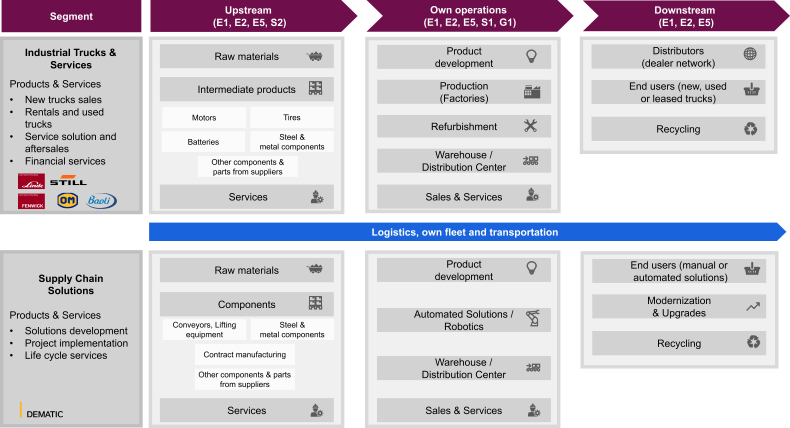
The material inputs of the KION Group’s upstream value chain include: engines, electric and other components, high-performance forged parts, counterweights and safety equipment, industrial tires, batteries, conveyor belts and components, structural steel components, and sheet steel components. To produce these inputs, raw materials such as steel, rubber, oil, lithium, and lead are required, in addition to energy. The key suppliers include companies from the automotive, metal construction, electronics, and battery production sectors. The KION Group follows a sustainable procurement approach with interlinked phases: strategy development, risk assessment, risk mitigation, incident management, and corrective actions. The results of each phase feed into the next with the aim of using largely sustainable inputs and creating a circular process.
The conservation of resources is a core element of the KION Group’s strategy and business model and is aimed at minimizing consumption within the Group’s own value chain. Energy consumption and quantities of waste are the key factors influencing the KION Group’s value chain. The KION Group’s aim, therefore, is to offer its customers products and solutions in the future that are resource-efficient as well as energy and cost-efficient. This already involves purchasing and using inputs and materials that were produced in a resource-efficient manner and allow easy reuse, repair, and remanufacturing. By taking appropriate action, the KION Group expects not only a reduction in resource outflows but also benefits, especially for customers, investors, and other stakeholders. The established KION Group brand companies set high standards of quality for their premium products and integrated solutions. A long product life and repairability are thus core elements of the KION Group business model. The product lifecycle can be extended through regular servicing and repairs, through modernization and modifications, and through upgrades to the materials used. The service and spare-parts business and the remarketing of used trucks following remanufacturing are therefore core elements of the KION Group business model. This means that KION products can be used by customers for a longer overall time in the downstream value chain.
As a manufacturer of industrial trucks and a provider of intralogistics solutions, it makes sense for the KION Group to take the whole value chain into account in its sustainability strategy due to the size of its supplier base. But this is also a highly complex task due to the number of stakeholders along the process chain. The business model of the Industrial Trucks & Services segment covers the key process steps of the value chain to fully cater to the needs of material handling customers worldwide: product development, procurement and manufacturing, sales and service, truck rental – including short-term rental – and used trucks, fleet management, and financial services through lease agreements that support the core industrial truck business.
The product portfolio is complemented by services that cover the customers’ use of the products. The spare parts business and the provision of service packages for repair and maintenance underpin the longevity and efficient use of these products. Through these recurring services, the refurbishment of used forklift trucks, such as returns from leasing agreements, and the remarketing of used trucks and trucks that have undergone a major overhaul (remanufacturing) represent further important building blocks in the downstream value chain in terms of circularity.
The product portfolio of the Supply Chain Solutions segment, with Dematic as one of the world’s leading warehouse automation providers, comprises intelligent supply chain solutions, automation solutions, and the offering in the autonomous mobile robot (AMR) segment. The business activities of the Supply Chain Solutions segment are rounded off by the service business (customer services), which includes the maintenance, modernization, and upgrading of installed equipment. »Further information can be found in the ‘Business model and organizational structure’ section in the ‘Fundamentals of the KION Group’ chapter of this annual report.«
The KION Group offers its customers a wide range of products, including all related services and logistics solutions to enable the flow of material and information within factories, warehouses, and distribution centers. Besides its sales business, the Group offers customers – as end-users – options for the transition to a circular economy that include the acquisition of used trucks, short- and long-term lease financing models, the short-term rental of equipment or rental fleets, and the modernization and upgrading of existing automation solutions. The KION Group’s distribution channels comprise trade fairs and an established network of dealers in addition to its direct sales activities. Thanks to its long-standing customer base in both operating segments, KION has a strong relationship with its customers, although its market position can be impacted by the competition at any time. In order to cater as fully as possible to customer requirements in relation to resource-efficient products in the downstream value chain, the KION Group must therefore also consider customer interests when dealing with the upstream value chain. A functioning supplier management system with rules and policies for suppliers is thus essential for monitoring the inputs that are purchased.
But it is important to take into consideration that certain inputs can only be purchased from a limited number of suppliers, meaning that there is a certain dependency on suppliers for KION’s own operations. By acquiring companies – for example those operating in the production of frames for industrial trucks or in IoT-based software – and establishing its own lithium-ion battery production and own fuel cell production, the KION Group has already expanded its business model with the aim of becoming more resilient.
Due to the large number of leasing agreements, industrial trucks in the Industrial Trucks & Services segment are temporarily reintegrated as lease returns into the KION Group’s portfolio at the end of the contractual lease period. Refurbishment provides at least one more product lifecycle for these trucks as used trucks, and refurbished products can also be used again in the circular economy. Because the majority of materials are recyclable, equipment is returned to the material flow through the recovery of resources at the end of its initial life. The increased use of recycling is an example of recovery here. This lifecycle management comprises the rental, leased, and used truck businesses, as well as repair, maintenance, upgrading, and remanufacturing activities and the recycling of lithium-ion batteries. Through the strategic partnership with Li-Cycle Holdings Corp., the critical conflict minerals used in the Group’s lithium-ion batteries are used to manufacture new batteries thanks to the almost complete recovery of the minerals at the end of the first lifecycle. Coupled with the inhouse production lines, this arrangement means that the resource-efficient battery lifecycle from production to mineral recovery is a closed loop in the KION Group.
In the Supply Chain Solutions segment, the automation solutions set up at customer sites are predominantly large-scale installations with numerous individual components. As supply chain installation projects for these customized systems can take a long time, often up to several years, and frequently involve considerable capital expenditure by the customer, the durability of these installations is of key importance to customers. Modifications and upgrades – including energy-related actions – and the standard spare parts and service business also extend the product lifecycle. Beyond this solution-oriented product lifecycle, materials from these largely bespoke installations and facilities are returned to the materials cycle as far as possible through recycling.
As maintaining long-term customer loyalty is a key factor in the Company’s success, distribution channels also play an important role in the KION Group’s business model. With this in mind, the KION Group follows a hybrid sales strategy. Besides a network of dealers and direct sales through field staff, a key role is also played by trade fairs, digital trading platforms, and other digital sources of information. The digitalization and connectivity of the KION Group’s own trucks, tools, and customer installations help to reduce the volume of business travel by field staff and thus limit carbon emissions. Additional physical and virtual showrooms with 3D product visualization and special design tools allow customers to get a personal insight into the product portfolio or automation solutions before the actual production or installation commences. This conserves resources and cuts GHG emissions.